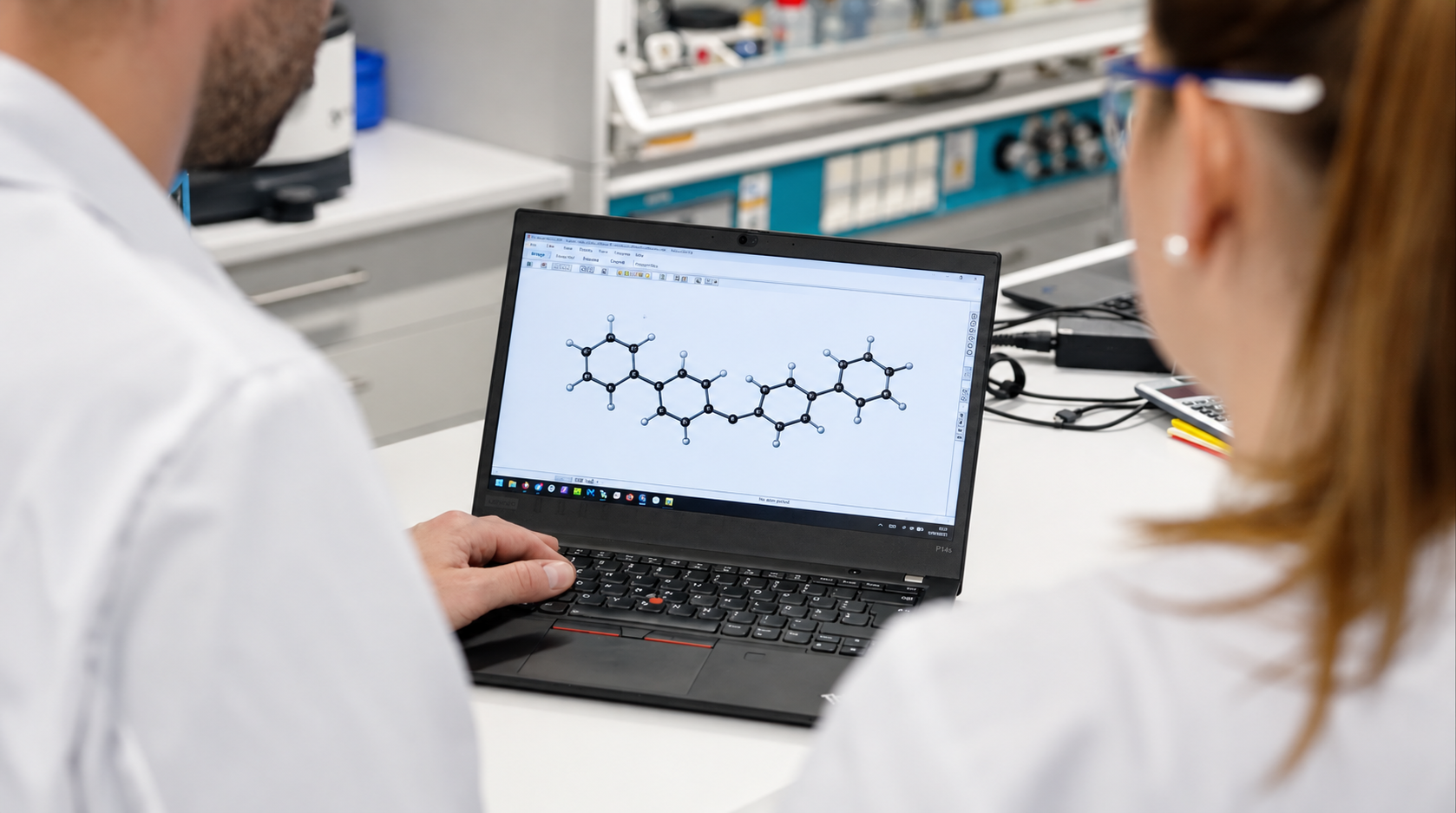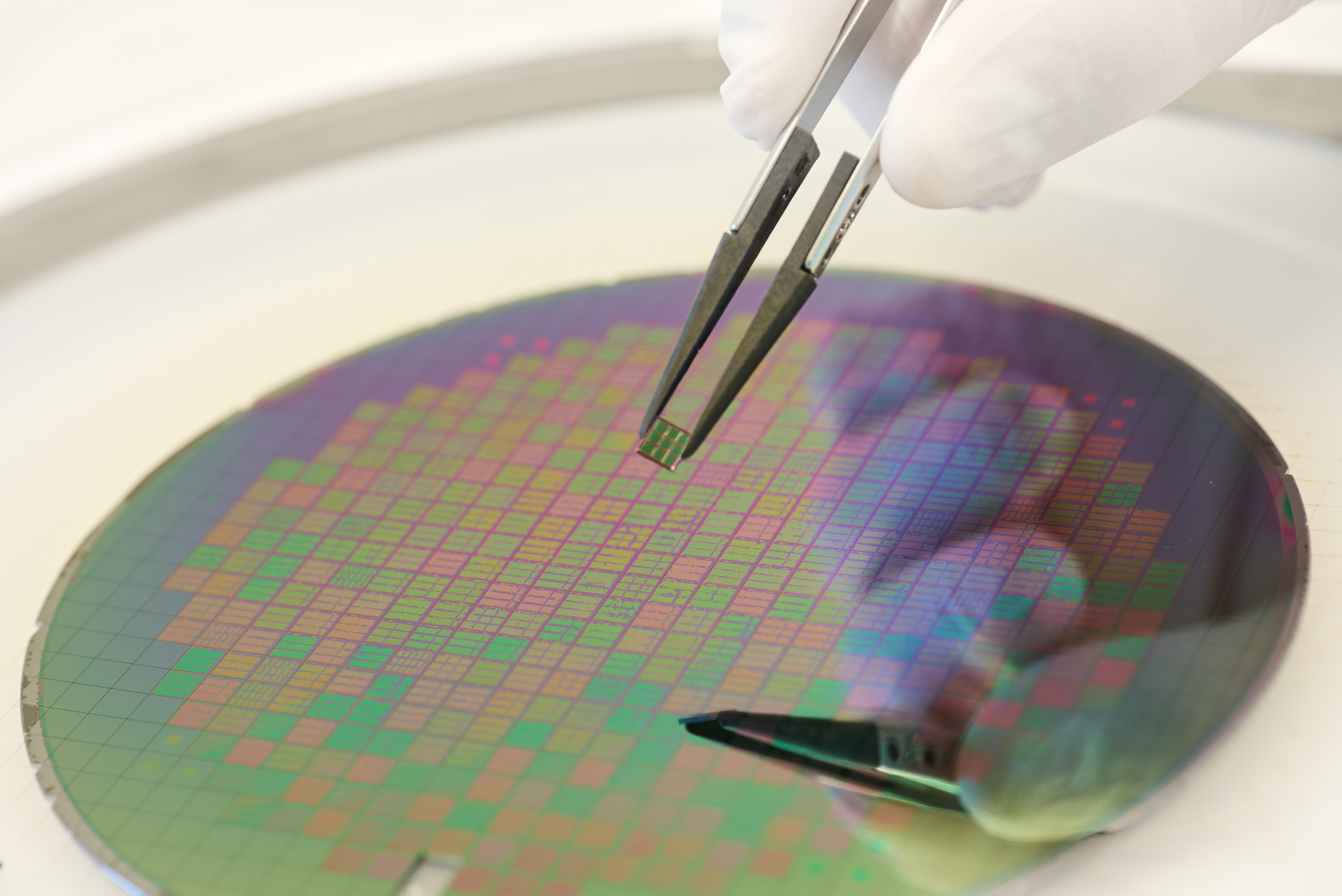
Most quantum hardware starts with a material whose properties are already set by nature, leaving engineers to work around its limitations. We took the opposite approach. Our team started with a list of the properties a quantum computer needs, then designed a molecule to have them, a crystal to house it, and a way to activate each molecule with a laser. The idea was to solve the hardest part of the problem in the molecule’s design from the start. Our paper, A Single-Molecule Spin-Photon Interface, now published in Nature, shows the result: the first individually addressable organic molecular qubit with a photonic interface. It is a single molecule whose spin is prepared and read out with light, is controlled with microwaves, and holds its quantum state for milliseconds.
In our PIQC architecture, each molecule plays two roles. Its electron spin is the interface: the part that talks to light and connects molecular qubits to one another. Nuclear spins, built into the same molecule by design, act as long-lived memories. This paper demonstrates the first of these roles: the electron spin of a single molecule that can be prepared, controlled and read out, with light connecting it to the outside world.
Here we walk through how we built this molecule, why each design choice mattered, and what the measurements show.
The properties needed for scale
Quantum computers have made remarkable progress over the past few years. Trapped ions, superconducting circuits, and neutral atoms have all shown that errors can be detected and corrected in increasingly large systems, a key step toward building reliable machines. But moving from reliable quantum computers to useful ones will require a much bigger leap in scale. Useful machines will need hundreds of thousands of qubits or more, and every qubit added to a single system makes noise, interference and control harder to manage.
There's a growing consensus in the community that the way forward is to divide quantum computers into many smaller units and link these together with light. Photons already carry much of our digital information through optical fiber and they are the natural choice for linking quantum systems over distance.
That approach depends on a component called a qubit-photon interface. In a networked quantum computer this isn't an add-on; it's built in. It’s the link between the computer’s stable memory (its qubits), where quantum information is held, and the photons that carry that information from one unit to another. In PIQC, this is achieved by a molecule acting as a spin-photon interface. For it to work at scale, the interface needs four things at once:
- Spin-dependent light. When a laser excites the emitter (in our case, the molecule), whether it glows depends on its spin state. The light it gives off can be entangled with the spin: the photon and spin share a single quantum state, even once the photon has traveled away.
- Long coherence. The spin must hold its quantum state long enough to be controlled and used in quantum operations (the target is more than a millisecond).
- Bright, fast emission. The emitter must give off photons quickly, in order for high-fidelity operations to be much faster than the coherence time.
- A narrow, stable frequency. The spectral line must be very narrow and must not drift, so that photons from different emitters are identical, which is essential for entangling them.
Several platforms, from trapped ions to defects in diamond, have made impressive progress on this list but meeting all four requirements at once, in a form that can be made at scale, has up until now been an open challenge.
In conventional spin qubit approaches, qubits that can be linked by light are often defects in crystals such as diamond or silicon carbide. For these, researchers have used sophisticated engineering to improve one property or another but a defect's properties are largely set by the material it sits in, so tuning it to meet every requirement at once is extremely difficult.
Our approach with PIQC starts from a different premise: molecules can be designed. Chemists can decide which atoms go where, and synthesize identical copies. Swapping one chemical group for another can shift the frequency of a molecule's light, how brightly it glows, or how its spin behaves. That opens up a different way of working: decide what you need, then design a molecule to deliver it.
Getting to the right molecule
Designing a molecule to meet all four requirements at once took both simulation and experiment. Over about four years, the team modeled roughly 200 candidate molecules and synthesized more than 40 of them. Organic chemists, spin physicists and quantum-optics specialists worked in a tight loop, feeding each measurement back into the next design, until it became clear which chemical changes produced which quantum properties. The turning point came at the end of 2025, when the team could suddenly see thousands of bright, single-molecule emitters under the microscope.
Those emitters were the "Goldilocks" molecule the team had been looking for. Three key design decisions made it work.
Design decision 1: the molecular qubit
The molecule at the heart of this work is a carbene: a molecule with a central carbon atom carrying two unpaired electrons. Each electron has a spin and the quantum information is stored in the combined spin of these two electrons. Together, the molecule and its spin make a molecular qubit: the molecule is the container, and its spin holds the information.
Those two electron spins line up in parallel, forming what is called a "triplet", which has three possible spin states. The qubit is encoded in these states. Crucially, the triplet is the molecule’s electronic ground state (its lowest-energy, resting configuration), so the qubit doesn’t need to be kept in a short-lived excited state to exist.
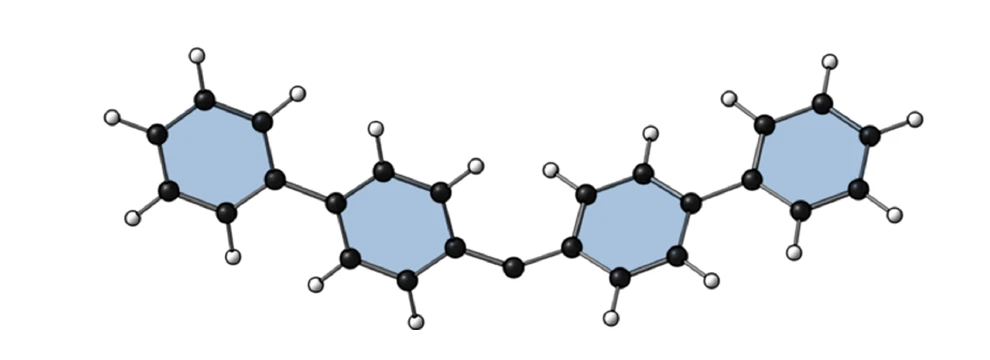
Two biphenyl "arms" (each a pair of linked carbon rings) extend from the central carbon. The molecule is purely organic, built from carbon and hydrogen with no heavy metal atoms. That matters because heavy atoms tend to disturb electron spins and shorten how long they last.
Before measuring anything, the team modeled the molecule inside its crystal on a computer. The calculations predicted three properties that proved essential:
- A sharp spectral line. When the molecule absorbs light, it moves into a higher-energy state, but that change barely alters the molecule’s shape so less energy is diverted into vibrations. As a result, a large share of the emitted light comes out at a single, precise frequency (the “
zero-phonon line”) rather than being spread across a broad band. - A different frequency for each spin state. When the molecule is excited, the energy difference between its possible spin states changes substantially. As a result, each spin state absorbs laser light at a noticeably different frequency so a laser tuned to one frequency can “ask” the spin which state it is in.
- A built-in reset. Thanks to the molecule’s symmetry, shining a laser on it prepares its spin in one particular state. That gives the qubit a known starting point before a quantum operation begins.
Design decision 2: a crystal host for the molecule
A molecule on its own vibrates, flexes and, in the case of a carbene, readily reacts with its surroundings. To preserve its sharp light and long-lived state it needs a stable home. The team designed the host crystal to be made of a near-identical twin molecule: one with the same framework, but with the central carbon swapped for a carbon-oxygen (ketone) group.
Because host and guest have almost the same shape, the molecular qubit slots into the crystal in place of a host molecule, with minimal disruption to the crystal around it. The crystal also does useful work of its own:
- It flattens the molecule. In free space, the rings in each biphenyl arm twist about 36° relative to each other. In the crystal, they are held nearly flat, at about 6°. A flatter, more rigid molecule changes shape less when it absorbs light, so more of its light comes out in the zero-phonon line, the molecule’s sharp optical emission. Around 19% of all the light emitted falls in this line, a share that can be boosted further by placing the molecule in an optical cavity.
- It keeps neighbors at a distance. The way the molecules pack reduces how much the molecule’s electrons overlap with the surrounding host.
- It's electrically quiet. The host is built from molecules with no dangling bonds, so there are few stray electric charges, a common source of noise in many solid-state materials. Fluctuating charges can shift the frequency of a qubit’s light; without them, the molecule’s light stays sharp and stable.
The crystals are grown with standard chemistry techniques over a few days, from millimeter-sized pieces down to plates thinner than a micrometer. All are clear and well ordered, allowing a laser to be focused precisely and the molecules’ light to be collected cleanly.
Design decision 3: switching the qubit on with light
Carbenes are highly reactive, so they can't simply be made in a flask and stored. Instead, the team built a stable "precursor" molecule into the crystal. A focused laser pulse knocks a nitrogen molecule off the precursor, turning it into the carbene, the active molecular qubit, right where it sits.
This turns a chemistry problem into a precision tool. The crystal can contain many inactive precursor molecules, but only those exposed to the activation laser are converted into molecular qubits. By controlling where and how much the crystal is illuminated, the team can therefore choose the location of the qubits with sub-micrometer precision.
That control is what made it possible to go from dense clusters of molecular qubits to regions sparse enough to find and study just one. It also matters for the future. Because the molecular qubits are created after the crystal is in place, they can be activated exactly where they're needed on a chip, for example on top of an optical cavity, without having to place the crystal itself with nanometer precision.
What the measurements show
The paper's central result is that all of this works in a single molecule. Over the past decade, researchers have made important progress with molecular qubits, including reading out molecular spins with light. But those results came from ensembles: large numbers of molecules measured together, giving an average. A conventional computer's memory doesn't store information as an average across millions of transistors; each bit is written and read on its own. A scalable quantum computer needs the same from its qubits. This work demonstrates the first individually addressable organic molecular qubit with a photonic interface.
The first step was to find and confirm a single molecular qubit. All measurements were made at 4.5 K (around −269 °C), in a custom-built microscope that can focus on a tiny spot of the crystal while keeping it cold. In regions where only a few molecules had been activated, individual bright spots appeared. To confirm that a spot was a single molecule, the team checked whether its light arrived one photon at a time. A standard test (the g⁽²⁾ autocorrelation) showed the presence of a single emitter.
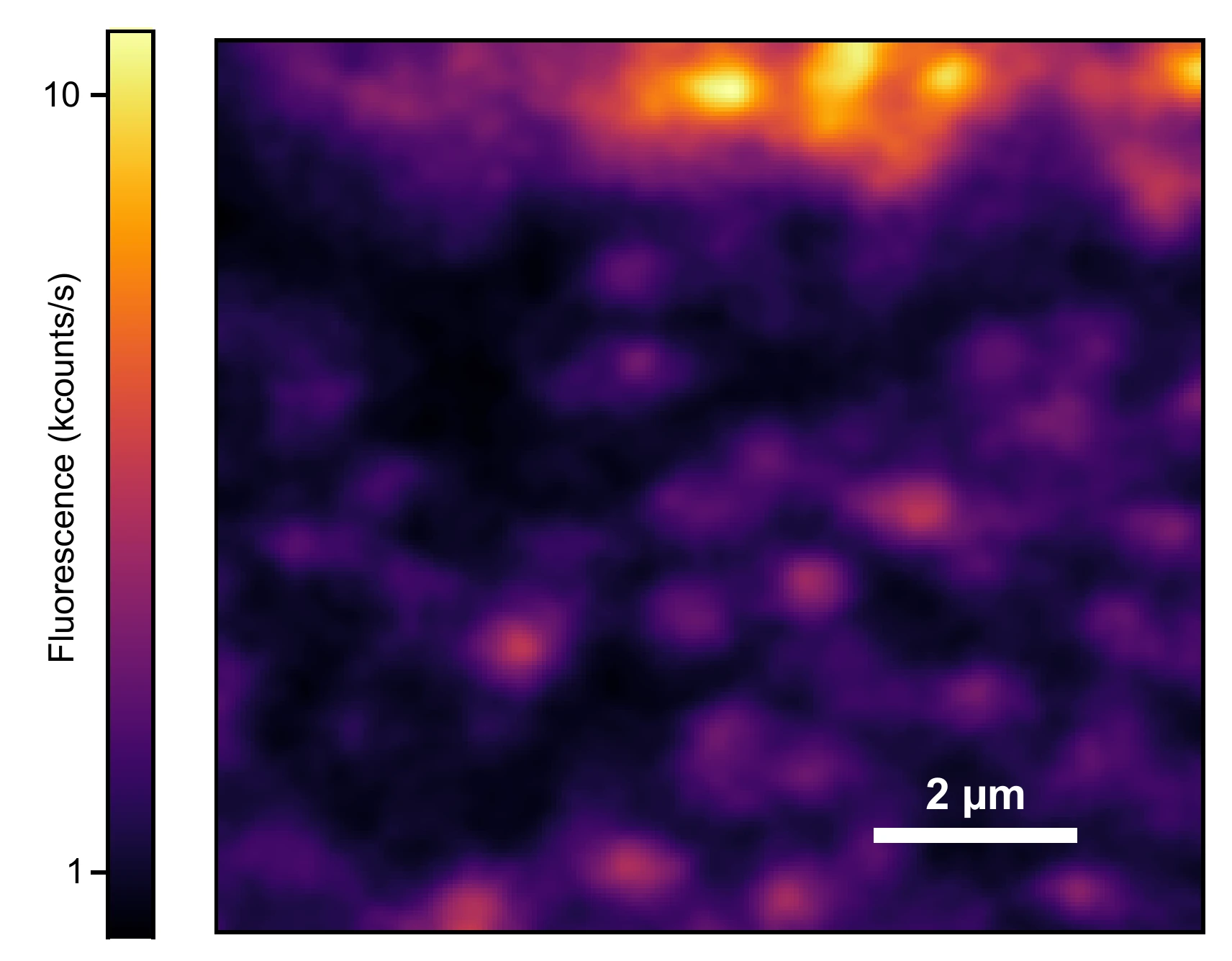
With a single molecule confirmed, the team tested it against the four requirements set out earlier.
- Spin-dependent light. The first question was whether the molecule's light reveals its spin. What the team saw is that the frequencies linked to different spin states were separated by at least 1.555 GHz, about 40 times wider than the molecule’s spectral line. Think of two radio stations far enough apart on the dial that tuning into one never picks up the other. This result means that when the laser is tuned to one spin state's frequency, the molecule glows if its spin is in that state and stays dark if it isn't. That's a direct optical readout of a single molecule's spin.
- Bright, fast emission. After exciting the molecule, the team saw that it emits its photon within about 24 nanoseconds, fast enough for rapid, repeated attempts to link qubits. Around 19% of its light comes out in the zero-phonon line, the sharp, usable part of the spectrum, helped by the crystal holding the molecule flat.
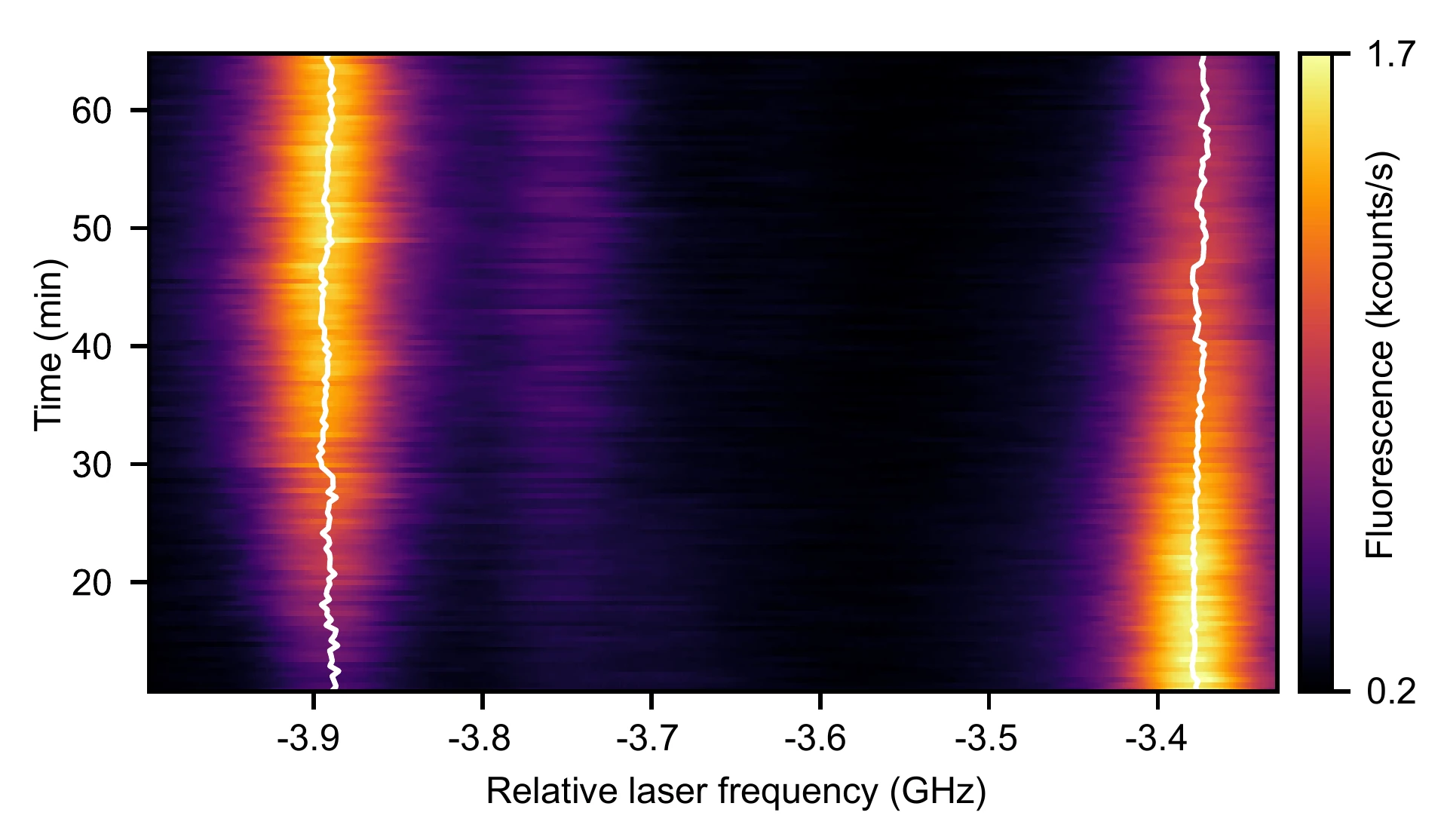
- A narrow, stable frequency. The zero-phonon line the team measured is remarkably sharp: only 38 MHz wide. Compared with the light’s frequency of around 500 trillion Hz, that spread is tiny: about one part in 13 million. The line is also within about six times the narrowest width physically possible for this molecule, a limit set by how long it stays in its excited state. Over more than an hour of repeated measurements, the frequency drifted by only about 2.5 MHz. That stability matters because linking two molecules depends on their photons being indistinguishable: if a detector could tell which molecule a photon came from, the entanglement would fail.
- Long coherence. Reading the spin is only half the job; a qubit also has to be controllable. Between laser pulses, microwaves were used to rotate the spin back and forth between states (known as Rabi oscillations), showing the spin can be controlled on demand. Light then resets it, ready for the next round.
The same microwave control was also used to measure the last requirement: how long the spin holds its quantum state before noise from its surroundings scrambles it. This is the coherence time.- With a simple protective pulse sequence (a Hahn echo), coherence lasted 12.2 microseconds.
- With a longer protective sequence (XY8 dynamical decoupling), it reached 2.2 milliseconds.
Part of the molecule’s long coherence time comes from its design. Its spin states are well separated in energy, which decouples the spin from the weak magnetic fields of nearby hydrogen atoms that could otherwise disturb its quantum state.
What makes a long coherence time valuable is how many operations fit within it. Flipping the spin from one state to the other takes less than 50 nanoseconds, so tens of thousands of such operations fit within the coherence time before the information fades.
A useful rule of thumb: the accuracy of an operation is limited by how long it takes compared with the coherence time. If an operation takes 0.1% of the coherence time, it can in principle reach about 99.9% accuracy, the level needed for error correction. Here, a spin flip takes well under 0.01% of the coherence time.
For context, these values are more than ten times beyond results previously reported for molecular qubits. They also bring molecular qubits into the range of established solid-state qubits: for example, the molecule’s coherence is already comparable to that of the silicon-vacancy center in diamond.
The key results at a glance:
What design makes possible next
The most exciting part of this result is that it’s a starting point. Several of the next steps below are already underway, and the team has new results to share in the coming months. Because the qubit lives in a designed molecule, its properties can be adjusted with chemistry, not just engineering:
- Built-in memory qubits. In our PIQC architecture, each molecule plays two roles. Its electron spin is the interface: the part that talks to light and connects molecular qubits to one another. Nuclear spins, built into the same molecule by design, act as long-lived memories. To achieve this, specific atoms can be swapped for isotopes with a nuclear spin (such as carbon-13) placed at exactly the same position in every molecule, a level of uniformity that’s hard to achieve in many solid-state systems.
- Ready for chips. The molecular crystals can be grown as very thin films, suited to being placed directly on established photonic chip materials such as silicon nitride or thin-film lithium niobate. Depositing thin organic layers is already an established industry: OLED screens, where every pixel makes its own light, rely on it in millions of phones. On those chips, photons entangled with individual molecules could be routed from qubit to qubit. The next test is keeping these properties intact on a real, fabricated chip.
- Room to go faster. An optical cavity could make the molecule emit photons more quickly, allowing more attempts to link qubits each second, but that would also broaden its optical lines. Usually, broader lines risk making the different spin states harder to tell apart. Here, however, the spin-state frequencies are separated by more than 200 times the molecule’s natural linewidth, leaving plenty of room to speed up emission while still reading out the spin cleanly.
- Tunable properties. Changing the molecule's structure can tune the frequency of its light, the spin's energy levels and how quickly it resets, to fit what a given application needs. The tools for this are the same ones pharmaceutical chemists use to fine-tune drug molecules, and the space of possible designs is vast.
We've set out how these pieces could come together into a full, scalable quantum computer in our PIQC architecture paper (arXiv:2605.21204). Important steps underway in our R&D labs include: gates between the electron spin and a nuclear memory, integration on photonic chips, heralded entanglement between separate molecules and, ultimately, error correction. This paper shows the core building block works.
Designed, not discovered
This work demonstrates something that hasn't been shown before for molecules: initialization, control and optical readout of a single molecular qubit, with coherence lasting milliseconds. More than that, it shows a way of building quantum hardware in which the qubit's properties are chosen by design. The molecule, its host crystal and the way it's switched on were each designed for a specific job, and each delivered.
A few years ago, the open question was whether a molecule with this combination of properties could be found at all. The question now is how to engineer it into a scalable system. For a technology that will need huge numbers of identical, well-behaved qubits, being able to design them from the atom up may prove to be one of the most groundbreaking tools there is.
— —- —- —-
Read the paper → Roggors, S. et al. A Single-Molecule Spin-Photon Interface.