
Quantum Computing Applications
Quantum computers represent and process information according to the laws of quantum mechanics. This makes them capable of solving problems beyond the reach of classical computers, from modeling molecules to optimizing complex systems.
Many promising algorithms for quantum computers already exist, but their practical impact is still limited by hardware. As quantum hardware scales, we expect rapid progress in performance and the emergence of new applications.
Quantum computing applications span four core domains: simulation, cryptography, optimization, data & learning.
Quantum Computing Application Domains

Simulation
Simulating quantum systems, like molecules, is intractable on classical computers. As a result, R&D often relies on fast but approximate methods, which can lead to suboptimal design decisions and longer development cycles.
Quantum computers represent and process information using quantum mechanics, allowing them to simulate these systems more naturally and with higher accuracy.
Simulation is one of the most promising and near-term applications of quantum computing, with huge impact in drug discovery, materials design, and chemical engineering.
Examples: optimization of candidates in drug development, battery materials for electric vehicles, catalyst design for chemical processes.

Cryptography
Modern cryptography relies on mathematical problems assumed to be unsolvable for classical computers.
Quantum algorithms (e.g. Shor’s algorithm) could solve some of these problems efficiently, making widely used schemes vulnerable. Quantum computing is therefore central to redefining secure cryptographic standards, and to testing and validating new schemes against quantum attacks.
Examples: factorization of large integers (RSA), discrete logarithms (Diffie–Hellman, elliptic curve cryptography)

Optimization
Optimization involves finding the best solution among many possibilities, such as the shortest route, the best portfolio composition, or the optimal design of a system. As the number of possibilities grows, these problems quickly become impractical to solve with classical approaches.
Quantum algorithms could explore large solution spaces efficiently and find high-quality solutions quicker.
This is one of the broadest areas for quantum impact, with use cases across logistics, manufacturing, finance, and more. However, due to current hardware limitations, a clear advantage over classical methods has not yet been demonstrated. Further progress depends on scalable quantum hardware.
Examples: route optimization in logistics, portfolio optimization in finance, production scheduling in manufacturing

Data & Learning
Understanding complex data - such as medical records, biological data, or financial markets - is computationally expensive, especially when many variables interact in subtle ways.
Quantum computing could enable new ways to model and analyze this data, improving pattern detection, generative modeling, and prediction. This could support new discoveries and more efficient workflows in data-rich fields such as biology and healthcare.
These approaches are still under active research and will be further validated as quantum hardware advances.
Examples: generative modeling of molecules and materials, pattern discovery in medical data, anomaly detection in complex datasets
Quantum Technology for Drug Development
Drug development has two core parts: discovering new drug candidates, and testing whether they actually work. The first focuses on identifying biological targets and designing molecules to interact with them. The second evaluates their effects in living systems.
NVision's quantum technologies could transform both:
Quantum computers could simulate how drugs interact with their targets with greater accuracy, leading to discovery and design of better candidates.
At the same time, quantum-enhanced MRI could rapidly validate the candidate’s efficacy in the true biological environment.
Together, these technologies will accelerate drug development and lead to the discovery of drugs for previously undruggable targets.
Quantum Advantage Across Drug Development Stages

Quantum Computing: Design
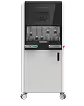
Quantum-enhanced Sensing: Validate

More targets

Stronger hits
Faster optimization

Better translation

Earlier decisions

Improved outcomes
Target Identification
Target identification is about finding biological targets that are directly linked to disease.
Today, this relies on large-scale analysis of genetic and omics data to generate hypotheses, which are then tested experimentally in laboratory models.
Quantum computers could help uncover hidden patterns and causal relationships in complex biological data - opening the door to new hypotheses and previously unknown drug targets.
Preclinical Testing
Preclinical testing focuses on validating the properties and efficacy of a drug candidate in living, non-human models.
Today, this relies on experimental studies to assess distribution, efficacy, and toxicity in biological systems.
Quantum-enhanced MRI could enable early, non-invasive measurement of target engagement and biological response in living organisms - making evaluation more predictive and improving the translation of results to the clinic.
Hit Discovery
Hit discovery focuses on finding molecules (“hits”) that bind to the target, even if only weakly.
Today, this is done by screening large libraries of compounds - both virtually, using fast but approximate methods to predict binding, and experimentally, using high-throughput assays.
Quantum computing could provide highly accurate reference data by simulating molecular interactions at the quantum level. This can improve the models used for virtual screening, making predictions more reliable and helping identify stronger hits earlier.
Clinical Trails
Clinical testing focuses on evaluating the safety and efficacy of a drug in patients through controlled studies.
Today, this relies on clinical trials to assess efficacy, monitor toxicity, and define optimal treatment strategies.
Quantum-enhanced MRI could provide early, non-invasive insight into patient response - enabling faster decisions on treatment strategies and go/no-go outcomes, and helping accelerate clinical trials.
Lead Optimization
Lead optimization focuses on turning initial hits into a promising drug candidate through an iterative design process.
Today, this involves predicting how molecular changes affect key properties, making targeted modifications, and testing them experimentally. This cycle is repeated until the candidate meets the desired profile.
Quantum computing could enable much more accurate predictions of binding, reactivity, and metabolism. Better predictions would help focus development on the most promising candidates, reduce the need for long costly design cycles, and reveal viable candidates that might otherwise be overlooked.
Treatment Optimization
Treatment optimization focuses on selecting and adapting therapies for individual patients.
Today, this relies on clinical experience supported by diagnostic tools.
Quantum-enhanced MRI could provide early, non-invasive insight into patient response - enabling treatment to be adjusted sooner and improving outcomes when patients are not responding as expected.