The quantum computing industry is coming to a tough realization: monolithic, single-chip architectures are hitting a scaling wall.
Whether building with superconducting circuits, neutral atoms, or trapped ions, qubit counts have saturated in recent years. While these approaches are viable for hundreds or even thousands of qubits, cramming millions of physical qubits onto a single processor has become a monumental engineering bottleneck.
To reach the era of utility-scale, Fault-Tolerant Quantum Computing (FTQC), there is a growing consensus that we must use photons to network smaller chips together. But building such a distributed quantum computer requires a "missing link" - a high-fidelity Qubit-Photon Interface (QPI) capable of entangling qubits across macroscopic distances. I.e. we need qubits that can compute locally and communicate optically. Until now, the hardware to do this at scale simply hasn’t existed.
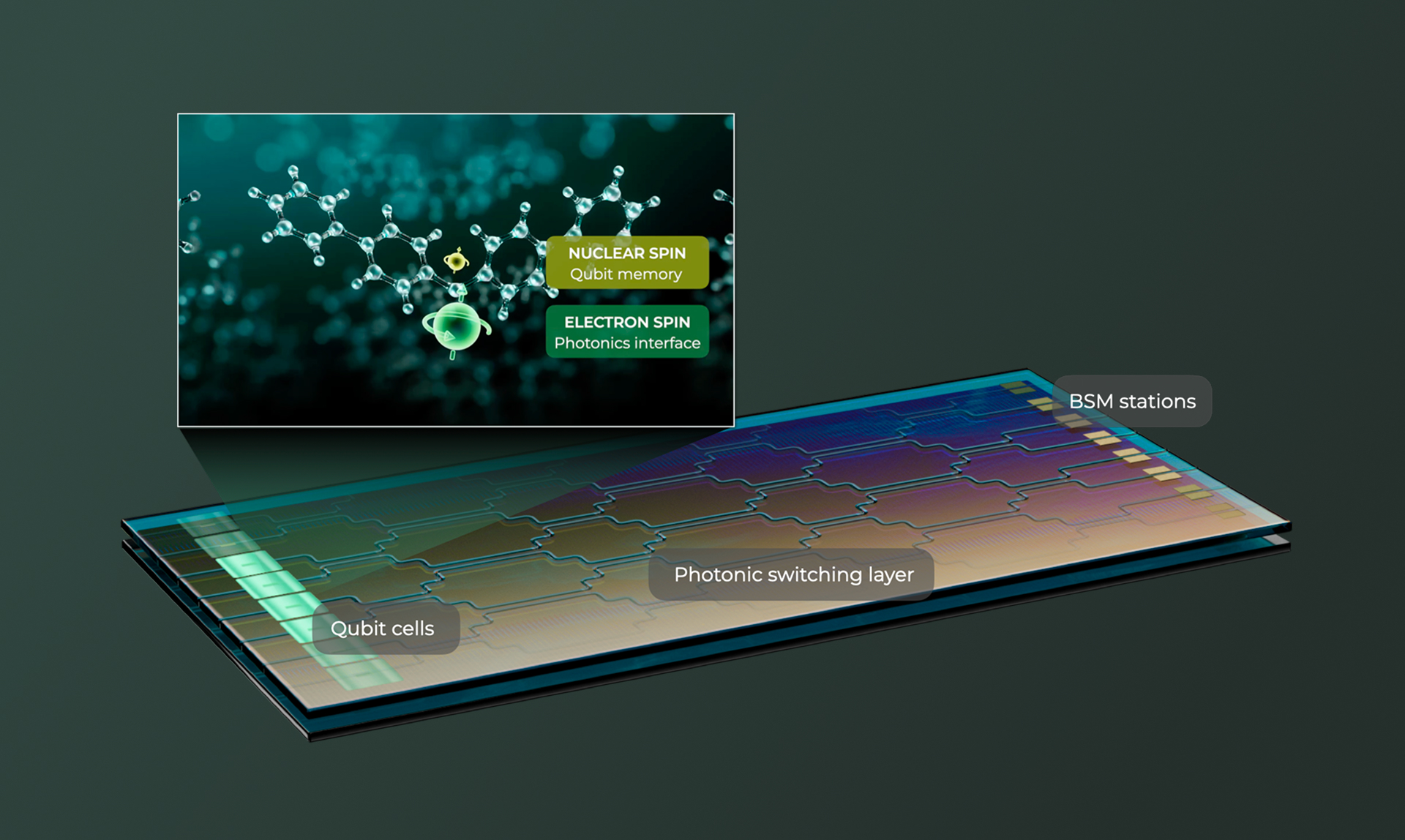
Today, NVision is bridging this gap by unveiling the full architecture behind PIQC (Photonic Integrated Quantum Circuits).
As Prof. Michael Levitt, 2013 Nobel Laureate in Chemistry, noted: "For decades, quantum technologies have largely depended on discovering the 'right' physical systems in nature... The material gives you what the material gives you, and progress comes from engineering around difficult constraints."
With PIQC, we flip this paradigm on its head. What if, instead of accepting what nature gives us, we built the ideal qubit from the ground up?
We are bringing organic chemistry into the core of quantum hardware. Using a purely organic, rationally designed carbene molecule (nicknamed BiPhi), we have engineered a quantum system that boasts both a long-lived nuclear spin to act as a robust memory qubit, and an optically active electron spin to serve as our native QPI.
Because we synthesize these molecules from the atomic level upward, their quantum properties can be tuned to match the requirements of photonic hardware. For the first time, the molecule itself acts as both the qubit and the connectivity layer.
However, an elegant molecular node is only the starting point. Scaling it into a 100,000-qubit QPUs, as part of quantum computers with tens of millions of qubits, requires a fundamentally new approach to system design. In our new whitepaper, we detail how PIQC combines BiPhi with four key ingredients to build a full-stack, scalable architecture:
- Integration with photonic integrated chips (PICs) - We strongly believe that to build a utility-scale quantum computer, we cannot reinvent the semiconductor fab. Instead, we designed our molecule to leverage the trillion-dollar PIC industry that already knows how to route light at scale. Because our purely organic qubits can be deposited as sub-100 nanometer thin films directly onto commercial PICs, they enable direct integration with existing mass-manufacturing methods.
- High photon loss tolerance - Our architecture relies on heralded remote entanglement, meaning that even if up to 70% of photons are lost in the routing network, the fidelity of the computation remains intact.
- Deterministic nuclear registers - To guarantee fast, high-fidelity gates between our qubits and QPI, we deterministically place carbon-13 or nitrogen-14 isotopic labels with atomic precision. Thus, all our molecular quantum nodes have the qubit at the exact same location, enabling fast (∼ 1 μs), high-fidelity electron-nuclear gates.
- Hardware-optimized quantum error correction codes - We utilize the inherent long-range connectivity in our system to implement high-rate quantum low-density parity-check (qLDPC) codes. To make these codes native to our system, we convert them into Floquet codes, reducing syndrome extraction to weight-two Bell-pair measurements that perfectly match PIQC’s networked hardware.
In the whitepaper, we lay out all these concepts and how they fit together. Later this year, we will publish our full blueprint, including a comprehensive resource estimation for achieving utility-scale quantum computing.
Read our full whitepaper on the PIQC architecture here.